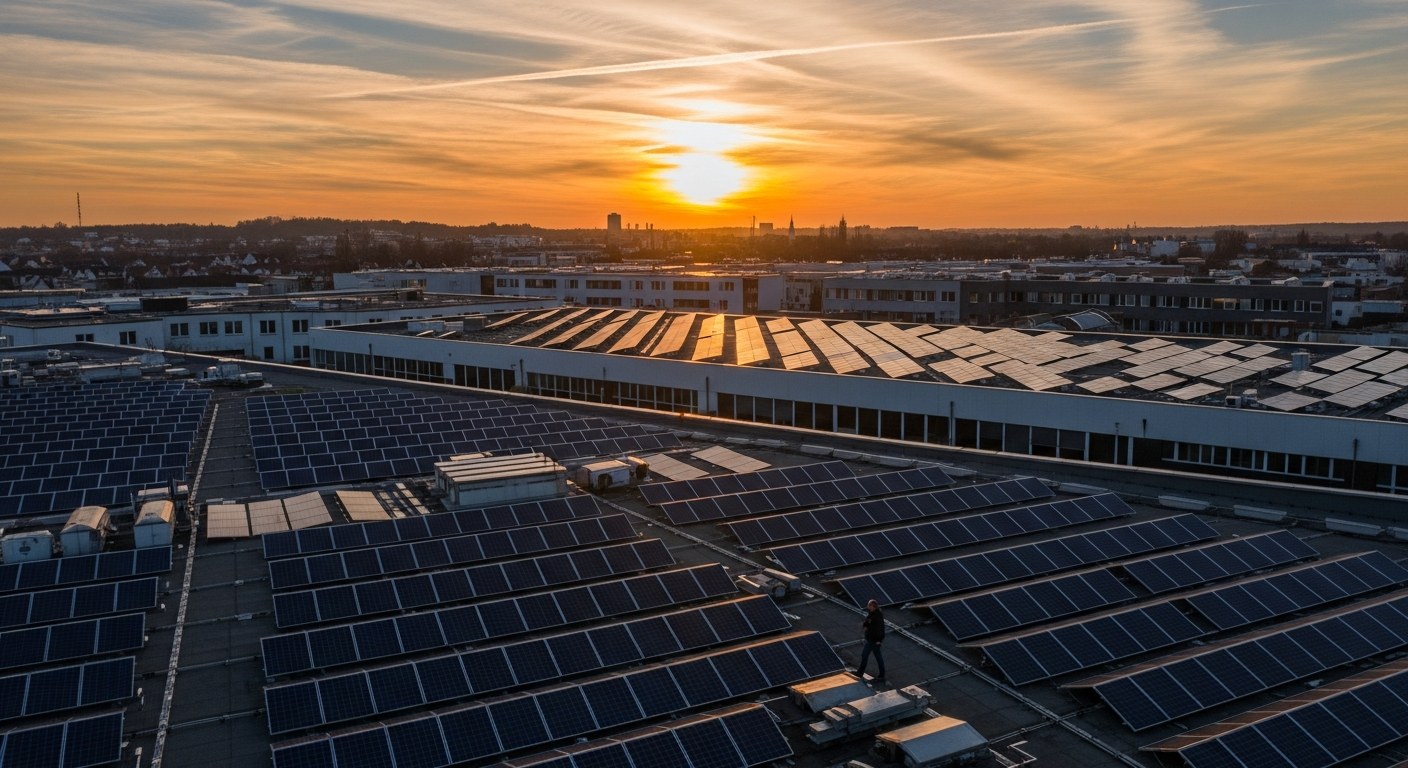
Europe’s Solar Build-Out Still Runs on Chinese Panels
Europe keeps adding solar capacity, but the trade data shows the energy transition remains structurally dependent on Chinese manufacturing.
Europe is still installing — but on imported hardware
Europe's solar market did manage to grow again in 2024, though much more slowly than the boom year before. SolarPower Europe said the EU added 65.5 GW of new solar capacity in 2024, edging above 2023's 62.8 GW but marking a sharp slowdown in growth.
That topline matters because it shows solar deployment is still happening at scale. But the more revealing number comes from trade data. Eurostat said the EU imported €19.7 billion worth of solar panels in 2023 and that China accounted for 98% of all extra-EU solar panel imports. Its updated 2024 trade data tells the same strategic story: China remained by far the largest partner, again accounting for 98% of extra-EU solar panel imports.
Europe, in other words, is expanding solar generation while remaining overwhelmingly reliant on Chinese hardware.
China dominates far beyond the final module
The dependence is not just about finished panels arriving in European ports. The deeper issue is manufacturing concentration across the whole PV stack.
The International Energy Agency has highlighted China's dominant share of global PV manufacturing capacity, from polysilicon and wafers to cells and modules. That matters because even if Europe assembled more modules locally, much of the upstream value chain would still sit in China unless Europe rebuilt multiple layers of production at once.
The result is a peculiar strategic asymmetry. Europe can accelerate deployment quickly because Chinese supply is abundant and cheap. But the very affordability that made solar politically scalable also hollowed out local manufacturing economics.
The slowdown makes the dependency more visible, not less
During the frenzy of 2022 and 2023, it was easy to focus on record installations and celebrate falling costs. In 2024, the picture became more complicated. SolarPower Europe described a major slowdown in growth as inventory imbalances, weaker power prices, grid constraints, and policy uncertainty hit parts of the market.
That matters because slower growth exposes the industrial question. When demand was surging, Europe could tell itself that cheap imports were simply accelerating decarbonisation. When markets cool, the harder question returns: who actually captures the margin, the jobs, and the strategic leverage?
The answer, for now, remains mostly China. Europe imports panels at massive scale, exports relatively little by comparison, and still lacks the integrated manufacturing base needed to reduce reliance quickly.
Why this matters for European operators and investors
For European founders, investors, utilities, and policymakers, solar dependency is no longer a niche supply-chain issue. It is central to the economics of the energy transition.
If Chinese producers continue to control price formation in modules and key upstream inputs, European project developers will benefit in the short term from cheap equipment while staying exposed to geopolitical shocks, trade disputes, and industrial-policy swings. If Brussels responds with protectionist tools alone, deployment could get more expensive before local manufacturing is ready to fill the gap.
That leaves Europe in a familiar position: strategically uneasy, commercially dependent, and operationally locked in.
The big story is not that Chinese panels dominate Europe. Everyone in the sector already knows that. The story is that after years of warnings, the dependency has barely loosened at all.
Sources
- https://www.solarpowereurope.org/insights/outlooks/eu-market-outlook-for-solar-power-2024-2028/detail
- https://ec.europa.eu/eurostat/web/products-eurostat-news/w/ddn-20241014-1
- https://ec.europa.eu/eurostat/statistics-explained/index.php/International_trade_in_products_related_to_green_energy
- https://www.iea.org/data-and-statistics/charts/china-s-share-in-global-pv-manufacturing-capacity-2024-and-2030
